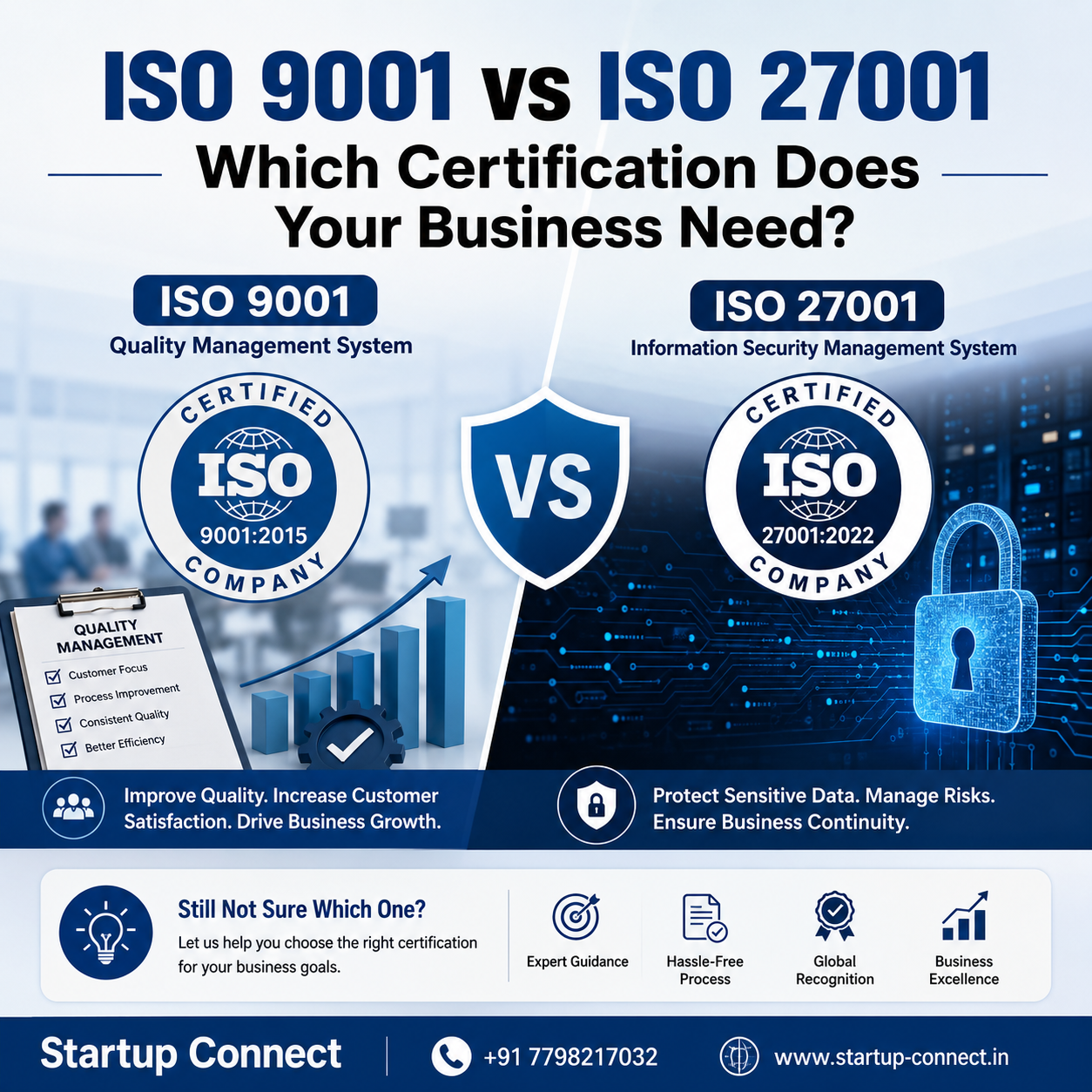
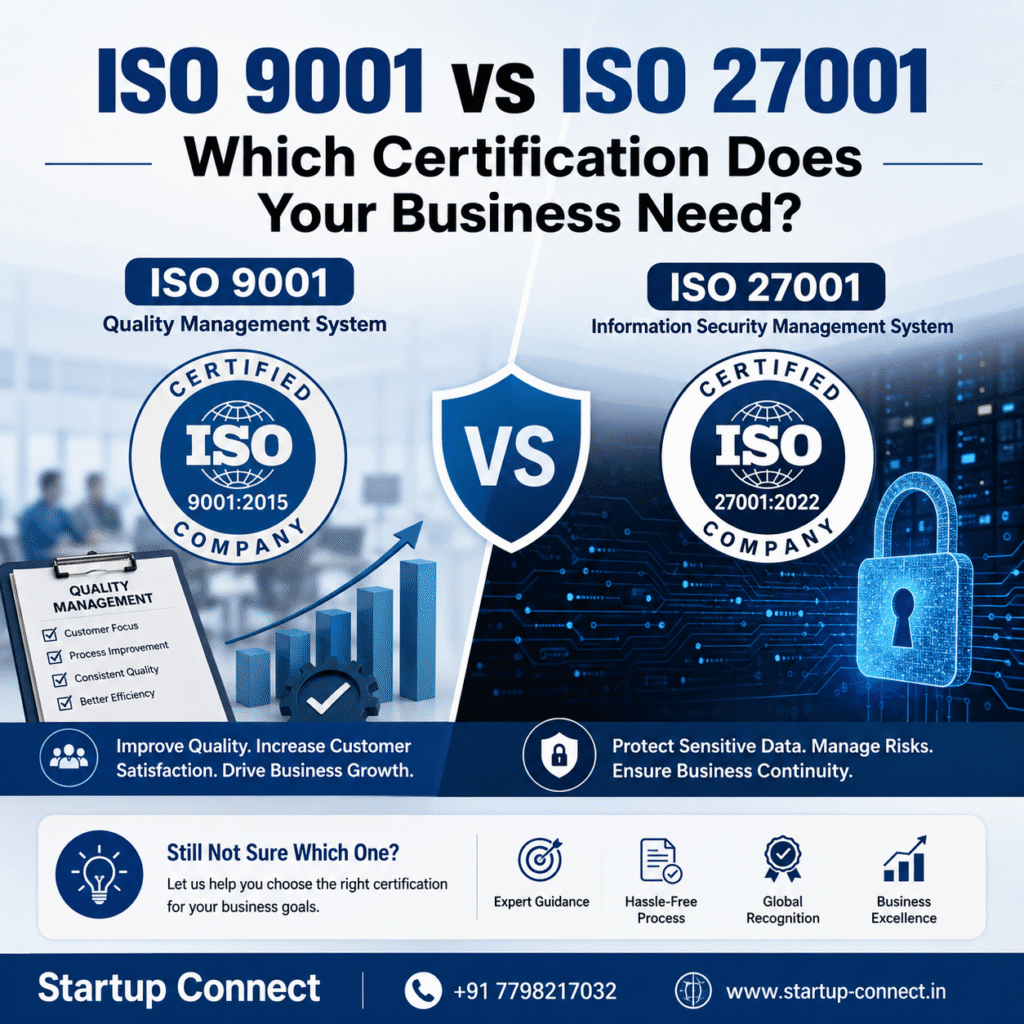
If you’re evaluating ISO 9001 vs ISO 27001 for your business, you’re not alone this is one of the most common questions we get from clients in Pune. Both are internationally recognized ISO standards, but they solve completely different problems, and picking the wrong one wastes both time and certification cost. This guide breaks down ISO 9001 vs ISO 27001 so you can decide which one (or both) your business actually needs.
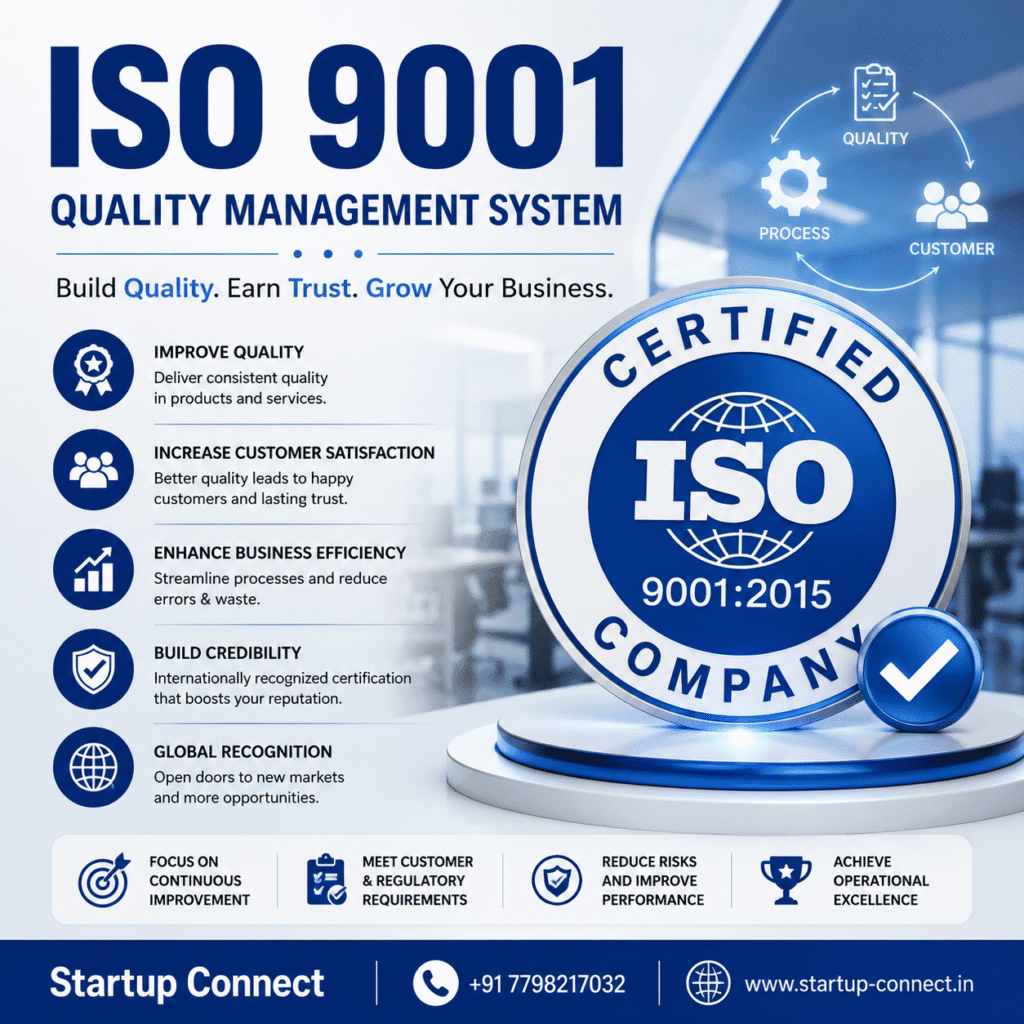
ISO 9001 is a Quality Management System (QMS) standard. It focuses on consistently delivering products or services that meet customer and regulatory requirements, through defined processes, continuous improvement, and documented quality controls. It’s relevant to almost any business manufacturing, services, trading, or consulting where consistent output quality matters.
ISO 27001 is an Information Security Management System (ISMS) standard. It focuses on protecting sensitive data — customer information, financial records, intellectual property — through risk assessment, access controls, and security policies. It’s especially relevant for IT companies, SaaS businesses, fintech, healthcare data handlers, and any business that stores client data digitally.
The biggest difference in ISO 9001 vs ISO 27001 is what each standard protects. ISO 9001 protects process quality and customer satisfaction. ISO 27001 protects data confidentiality, integrity, and availability. A manufacturing unit cares more about ISO 9001; a software company handling client data cares more about ISO 27001.
ISO 9001 suits businesses where product/service consistency is the buyer’s main concern — manufacturers, exporters, service providers bidding for tenders. ISO 27001 suits businesses where clients ask about data security before signing — IT/ITES companies, SaaS platforms, agencies handling client PII, or businesses working with international clients under GDPR-adjacent expectations.
ISO 9001 audits check your quality processes — how you handle customer complaints, defect tracking, corrective actions. ISO 27001 audits check your security controls — access logs, encryption practices, incident response plans, employee data-handling policies. The audit conversations are entirely different even though the certification process (Stage 1 and Stage 2 audits) looks structurally similar.
Generally, ISO 27001 certification tends to be more resource-intensive than ISO 9001, since it requires a formal risk assessment, security policy documentation, and often technical controls (firewalls, access management, encryption) that need to be demonstrably in place before certification. ISO 9001 documentation is comparatively simpler for small and mid-sized businesses.
ISO 9001 certification benefits show up mainly in operational consistency and customer trust — fewer complaints, better tender eligibility, standardized processes. ISO 27001 certification benefits show up in client confidence around data handling, which is often now a hard requirement in vendor contracts, RFPs, and enterprise client onboarding, especially for IT-adjacent businesses.
Yes many businesses eventually pursue both. A common path is: start with ISO 9001 to formalize quality processes, then add ISO 27001 once you start handling more sensitive client data or start bidding for enterprise/government contracts that require it. There’s no rule against holding both certifications simultaneously, and the two management systems can even be integrated under a combined framework to reduce duplicate documentation effort.
Ask yourself these questions:
For the official framework and standard requirements, you can refer to the ISO organization’s official documentation.
Both certifications follow a similar broad path gap assessment, documentation, implementation, internal audit, and final certification audit by an accredited body. The timeline typically ranges from 4-8 weeks depending on your current process maturity and business size.
If you’re still unsure which standard fits your business, our ISO Certification service includes a free consultation where we assess your business model and recommend the right certification — instead of pushing whichever one is easier to sell.
Small businesses can absolutely get ISO 27001 certified. Certification scope is scaled to your business size what matters is having proportionate security controls for the data you actually handle, not company size.
It isn’t universally mandatory, but many government tenders list ISO 9001 as a preferred or scoring criterion, which effectively makes it a competitive necessity in many sectors.
ISO 27001 certification requirements generally take longer to implement due to the risk assessment and security control documentation involved, often 6-8 weeks versus 4-6 weeks for ISO 9001, though this varies by business readiness.
Yes, both require surveillance audits annually and full recertification every 3 years to maintain the certificate.
Join our Newsletter to see latest Information
© 2025 Startup Connect. All Rights Reserved
Startup Connect is your trusted partner for business growth, offering Business Certifications, digital marketing, and branding solutions to help startups and enterprises scale faster.