
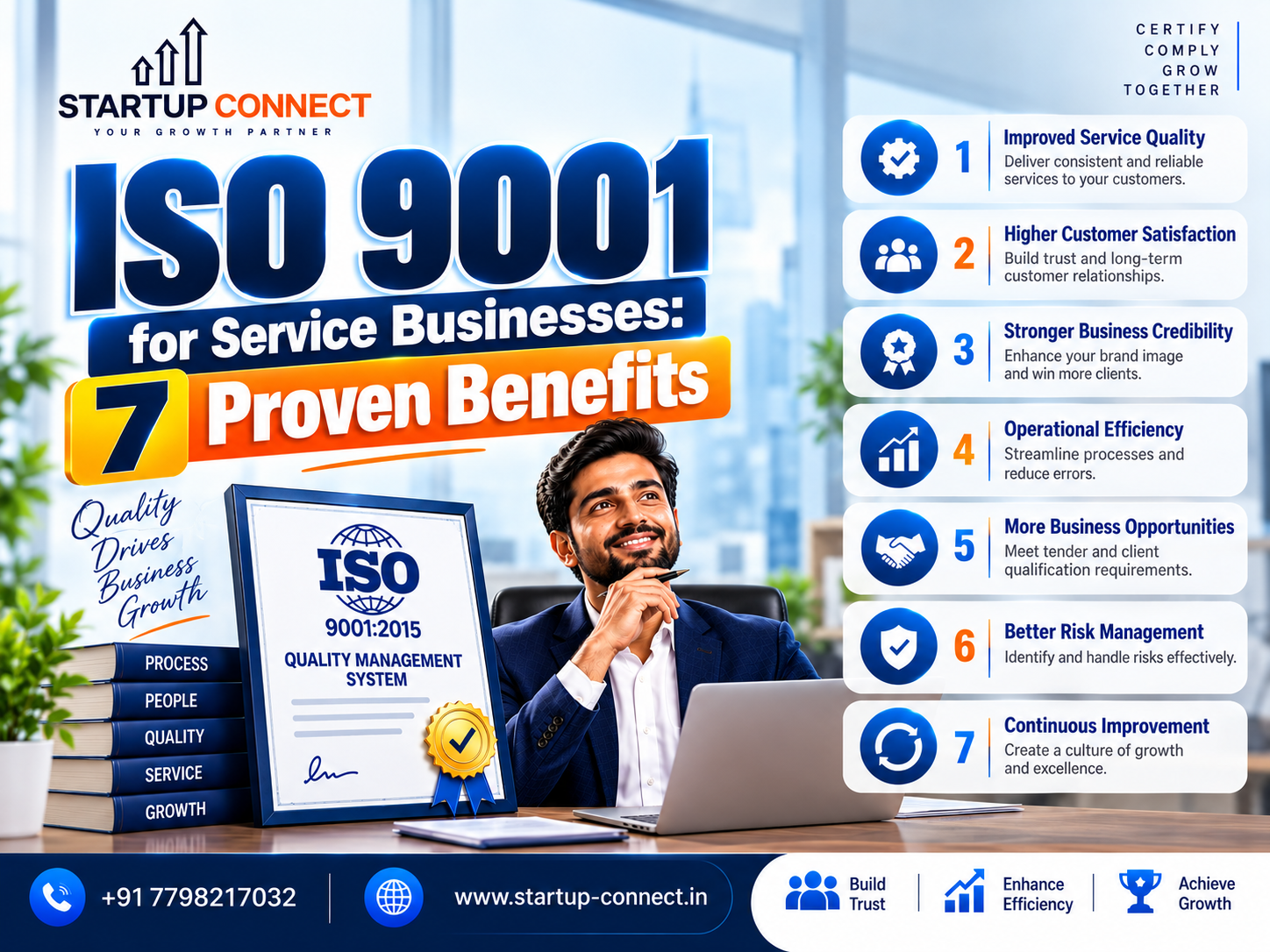
ISO 9001 for service businesses is one of the fastest ways to look bigger, more reliable and more professional than competitors who rely only on word of mouth. Whether you run a digital marketing agency, a salon or a local service company, ISO 9001 proves that your work follows a tested quality system. That proof helps you win larger clients, corporate contracts and higher-value projects. This guide explains what it means for your type of business, the benefits, the process and the mistakes to avoid.
ISO 9001 is the international standard for a Quality Management System (QMS). The current version is ISO 9001:2015. It does not say what your product or service must be. It says how you should plan, deliver, check and improve your work so customers get consistent results.
Many people assume ISO is only for manufacturers. That is a myth. The standard is written to suit any organisation, and services are one of its biggest user groups. A salon, an agency and a plumbing business all need the same things: clear processes, trained people, happy customers and a way to fix mistakes.
Service quality is hard to see before you buy. A customer cannot inspect a marketing campaign or a haircut in advance. So they look for signals of trust, and an accredited ISO certificate is one of the strongest.
Here is where it makes a difference:
In short, ISO 9001 for service businesses turns “we do good work” into “we can prove it”.
An ISO certification for a digital marketing agency helps you standardise client onboarding, reporting, approvals, data handling and campaign reviews. It also reassures larger brands that their data and deliverables are managed properly.
ISO 9001 helps you document hygiene routines, appointment flow, product handling and customer feedback. It suits chains, franchises and premium salons that want consistent quality across branches.
Cleaning, repair, installation, logistics and maintenance companies can use ISO 9001 to set job checklists, response times and complaint resolution. This is valuable when bidding for housing societies, offices and institutions.
The process for ISO 9001 for service businesses is more straightforward than most owners expect:
Timelines depend on your size and how organised your processes already are. Small service businesses can often be ready in a few weeks to a couple of months.
ISO 9001 certification cost in India is not one fixed number. It depends on:
Be careful with extremely cheap, “instant” offers. If there is no real audit and the certification body is not accredited, the certificate may be rejected by clients and tender authorities. You can read more about how we approach ISO certification.
A valuable certificate must be issued by a body accredited by a recognised accreditation authority. In India, this is NABCB, and it operates under the international IAF framework.
Avoiding these keeps ISO 9001 for service businesses a real business asset instead of just a wall frame.
Startup Connect helps service businesses with ISO certification, Udyam/MSME registration, DPIIT recognition and digital marketing to promote your credentials. If you want a practical, audit-ready system without unnecessary paperwork, contact our team. You may also want to explore MSME/Udyam registration to combine certification with government benefits.
Trust wins clients, and clients win growth. With a clear quality system, an accredited certificate and proper promotion, ISO 9001 for service businesses can help agencies, salons and local service providers compete for bigger contracts and command better prices. Start with a gap analysis, keep your processes simple and choose a genuine certification route.
It suits both. The standard is industry-neutral, and many agencies, salons, clinics, schools and logistics firms are certified.
Yes. Small businesses can get certified. The system just needs to be scaled to your size and processes.
Larger clients often use ISO certification as a vendor screening criterion. It signals that your quality processes are documented, reviewed and improved.
It depends on your readiness and size. Small businesses can often complete it within a few weeks to a couple of months, including audits.
The cost varies with your team size, locations, scope and the certification body. Ask for a clear quote that includes audit and surveillance fees.
Usually 3 years, subject to annual or periodic surveillance audits.
Confirm the certification body’s accreditation with NABCB or another IAF member, and check the certificate on IAF CertSearch where available.
No, it is voluntary. However, some clients and tenders may require or prefer it.