
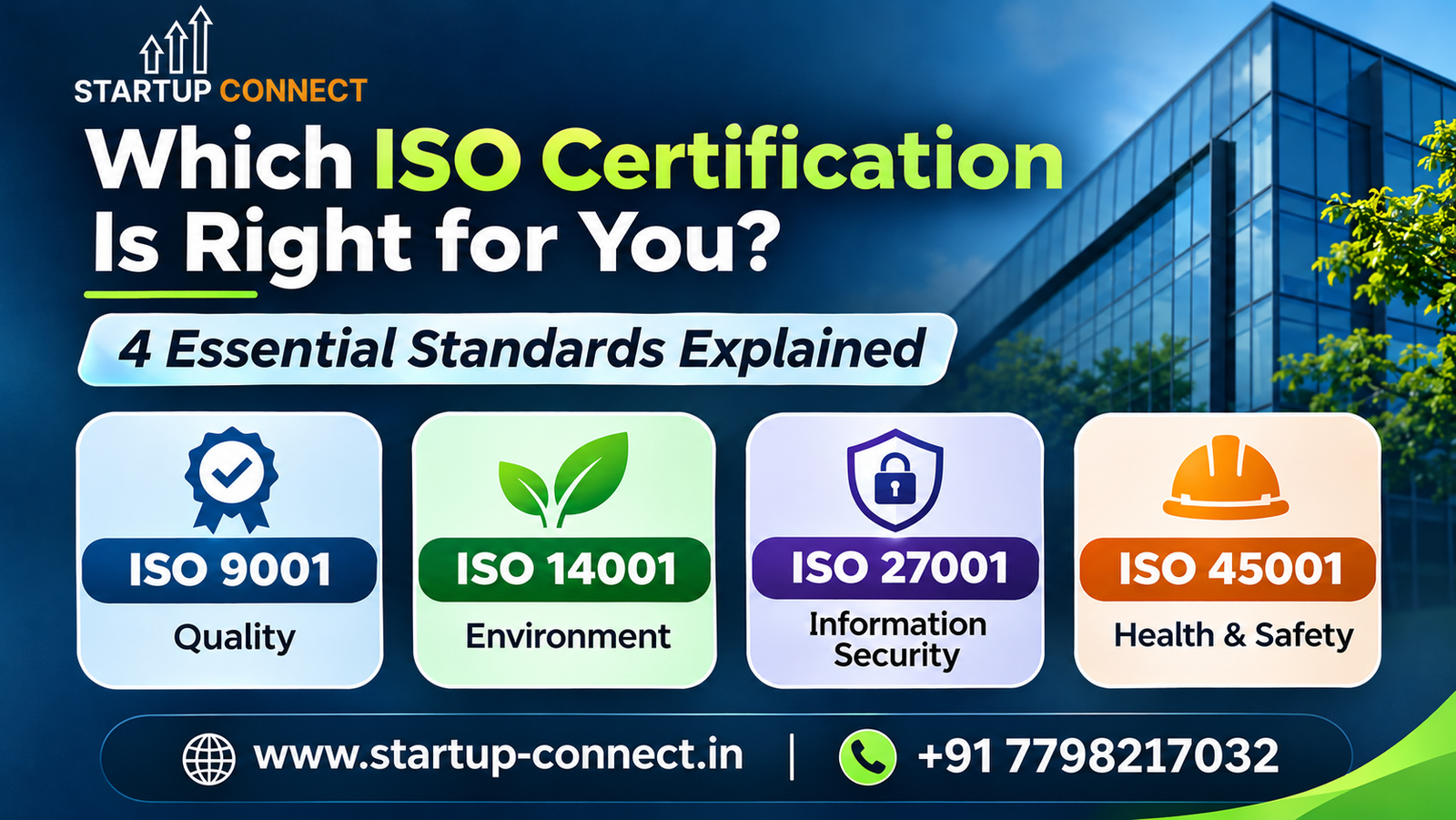
Choosing the right ISO certification can feel confusing when you keep seeing numbers like 9001, 14001, 27001 and 45001. Each standard solves a different business problem, from quality and environmental impact to data security and workplace safety. In this guide, we explain all four in simple language so you can pick the one that fits your business, your customers and your tenders.
ISO certification means an independent certification body has audited your business and confirmed that you follow an international standard published by the International Organization for Standardization (ISO). It is not a licence or a government registration. It is third-party proof that your processes meet a recognised benchmark.
For startups and MSMEs, this matters for three reasons:
If you have recently completed your Udyam registration, adding an ISO standard is a natural next step to strengthen your credibility.
Best for: manufacturers, traders, service providers and any business that wants consistent quality.
ISO 9001 is the most widely used standard in the world. It focuses on how you deliver products or services, handle customer complaints, control documents and improve over time. ISO 9001 certification is often the first choice for MSMEs because it applies to almost every industry and is commonly asked for in tenders.
Best for: factories, construction companies, chemical and waste handlers, and businesses with a visible environmental footprint.
ISO 14001 helps you manage waste, energy use, emissions and legal compliance. It is especially useful if you supply to large companies that track the environmental performance of their vendors, or if you work in export markets where environmental standards are strict.
Best for: IT companies, SaaS startups, BPOs, digital agencies and any business that handles client data.
ISO 27001 shows that you protect information through risk assessment, access control, data backup and incident response. ISO 27001 certification is increasingly demanded by international clients, banks and enterprise customers before they share sensitive data with a vendor.
Best for: manufacturing units, construction firms, warehouses and businesses with a large on-site workforce.
ISO 45001 focuses on preventing workplace injuries and illness. It covers hazard identification, safety procedures, emergency preparedness and employee participation. It also shows clients and regulators that you take worker safety seriously.
Standard | Focus Area | Ideal For | Commonly Required In |
|---|---|---|---|
ISO 9001 | Quality Management | Almost any business | Tenders, vendor onboarding |
ISO 14001 | Environmental Management | Factories, construction, waste handling | Industrial supply chains, exports |
ISO 27001 | Information Security | IT, SaaS, BPO, data handlers | Enterprise and international contracts |
ISO 45001 | Occupational Health & Safety | Manufacturing, construction, large workforces | Industrial and infrastructure projects |
Not sure which ISO certification you need? Use this simple guide:
If you are a small business and have a limited budget, ISO 9001 certification is usually the best first step. Tech companies should usually begin with ISO 27001 certification, because clients often ask for it during security reviews. You can add other standards later as your business grows.
The ISO certification process is similar for all four standards:
The cost of ISO certification depends on your company size, number of employees, number of locations, the scope of work and the certification body you choose. Timelines also vary. A small, well-organised business can finish faster than a larger company that is starting its documentation from scratch. Ask for a written quote that clearly separates consulting, audit and renewal costs so there are no surprises.
Most small businesses start with ISO 9001 because it applies to almost every industry and is widely accepted in tenders. IT and data-driven businesses often start with ISO 27001.
Yes. Many companies hold two or more standards, such as ISO 9001 and ISO 14001. Their management systems can be combined to reduce duplicate paperwork and audits.
An ISO certificate is generally valid for three years. During this period, the certification body conducts surveillance audits, usually every year, to confirm that you still follow the standard.
No. Any business that handles sensitive information, such as client records, financial data or intellectual property, can benefit. It is most common in IT, SaaS, BPO and consulting.
Generally, no. It is voluntary, but many tenders and corporate buyers make it a requirement for vendors.
Verify that the certification body is accredited by NABCB or another IAF member, and ask for the accreditation mark on the certificate. You can also contact the certification body to confirm the certificate number.
You lose the right to claim certification and may become ineligible for tenders that require it. You would usually need to go through a fresh certification audit, so plan renewal well in advance.